Reviews load shortly…
Provably fair · Live now
Aviator Game by Spribe: Free Demo, APK Download and How to Play
Aviator by Spribe: free demo, real odds, and a 1win bonus for your first flight.
By Arjun Mehta · Crash-game analyst · Reviewed 26 September 2026
97% RTP
8–30s Rounds
$0.10 Min bet from
2019 Live since
Aviatorby Spribe · provably fair
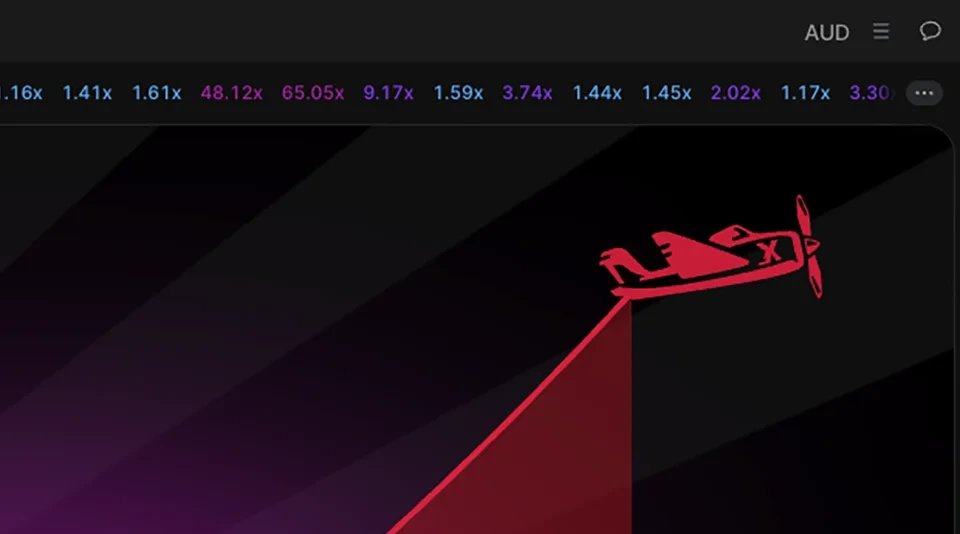
Aviator is Spribe's crash game: a plane takes off and a multiplier climbs from 1.00x. You pick a stake, then cash out before the plane flies away. Crash first, and the uncashed stake is gone. The format is fast, social and simple to grasp — but that speed means you need a firm budget and a realistic view of the odds before you start.
Here you'll find the Aviator game itself, free demo play, the interface, the Aviator APK question, predictor scams, operator limits and payment options for players in Kenya, Nigeria, South Africa, Ghana and India. The real-money button leads to 1win. If you're still learning the cash-out controls, start with the demo.
Spribe delivers Aviator through bookmaker websites and bookmaker apps rather than through a standalone player download. The game runs on desktop, tablet and mobile, and it's built to cope with lower-bandwidth connections and budget devices.
FREE DEMO
Aviator Free Demo Mode
The demo is the full game with a virtual balance: no sign-up, no deposit, the same live rounds other players are flying. Use it to learn the cash-out timing by hand, test Auto Cash-Out targets and watch how violently the multiplier swings before you risk a single shilling, naira or rupee.
Demo outcomes create no winnings and a demo balance has no cash value. When you move to real play, open with a small stake, set a session budget and decide your cash-out limit before the plane takes off.
THE GAME
What Is the Aviator Game?
Aviator in numbers
Aviator is a Spribe crash game with a 97% RTP, a 3% house edge and rounds of 8 to 30 seconds. The multiplier starts at 1.00x and rises until a crash point ends the round; you win by cashing out before that point. Spribe launched Aviator in early 2019, and the game now runs at more than 300 licensed operators, with Africa at 35% of the player base and India as its fastest-growing market.
Aviator is a crash game, an instant game and a social multiplayer game from Spribe. Everything revolves around one feature: a rising multiplier curve drawn as a climbing plane. Cash out a $1 stake at 2.00x and you get $2 back, before any operator-specific limits. Leave the stake active when the plane flies away and you lose it. That leaves only a handful of real decisions: how much to stake, whether to run one bet or two, and when to cash out.
A live bets feed, round history and chat sit alongside the action, so you can watch what everyone else is doing. None of that social noise changes the mathematics of the round.
Who created Aviator?
Spribe is a Georgian-founded studio tied to Tbilisi, with offices in Kyiv, Warsaw, Tallinn, Curaçao and the Isle of Man. It was founded in August 2018, with David Natroshvili as CEO and co-founder. Aviator went live in early 2019 — the timeline points to a January launch, and the first live launch on Adjarabet followed in February 2019.
A major Aviator 2.0 update landed on 15 August 2019. It made the game 40% faster, improved mobile play on slower connections and lower-end devices, added chat emojis and gifs, and introduced the Rain feature. Aviator reaches you as a B2B casino game through licensed operators and aggregators — Spribe doesn't sell it directly to players.
Is Aviator a slot?
No. Aviator is a crash or instant game rather than a traditional slot: no reels, no slot-style bonus round. The plane, the multiplier and the crash point form the complete round mechanic. Operators file it under Casino, Instant Games, Crash, Quick Games or Turbo Games in their lobbies.
Distribution since then has been enormous. Aviator was reported at more than 300 operators in December 2020, and certification coverage passed 20 jurisdictions in February 2022. Spribe reported more than 10 million monthly players in 2023. The later 42 million to 50 million-plus figures cover SPRIBE-wide activity, not Aviator alone.


HOW IT WORKS
How to Play Aviator
Open a bookmaker website or app and sign in. Find Aviator under Casino, Instant Games, Crash or Quick Games, pick your stake and wait for the next round. The plane opens at 1.00x, and the multiplier climbs until the predetermined crash point. Cash out in time and you bank stake × multiplier; hesitate, and the stake is gone.
Manual cash-out gives you direct control, but it lives and dies by reaction time, connection quality and device speed. Auto Cash-Out removes the reflexes from the equation: set a multiplier in advance and the game attempts to cash out the moment it is reached.
01
Choose a stake
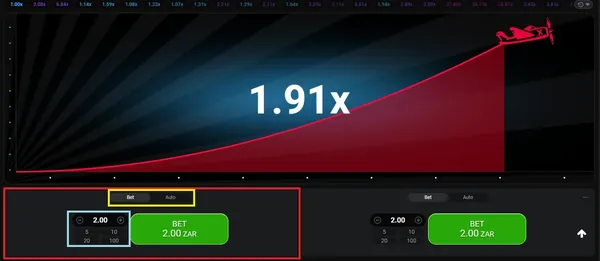
Select an amount in the first betting panel before the round begins. The minimum and maximum depend on the operator and currency.
02
Watch the curve
The plane rises while the multiplier increases. You can follow the live value, round history and other players' activity.
03
Cash out
Press the cash-out button before the crash to lock the displayed multiplier. If the crash comes first, the active stake is lost.
Using two bets
Aviator supports two independent betting panels in one round, each cashed out separately. Some players cover with one panel at a low target and hunt with the second — that is not a mathematical advantage, it just changes how the result is distributed between the two stakes and makes a round easier to manage.
Auto Bet and missed cash-outs
Auto Bet can repeat a stake across a selected sequence of 10 to 100 rounds, with stop conditions like a win or loss amount. Automation does not predict a crash and does not improve the expected return — treat it as a convenience and set a hard stop before activating it. And if you miss the crash, the stake on that panel is lost; a stable connection and Auto Cash-Out reduce avoidable time-outs, but nothing rescues a bet whose target was never reached.
INTERFACE TOUR
Aviator Interface Guide
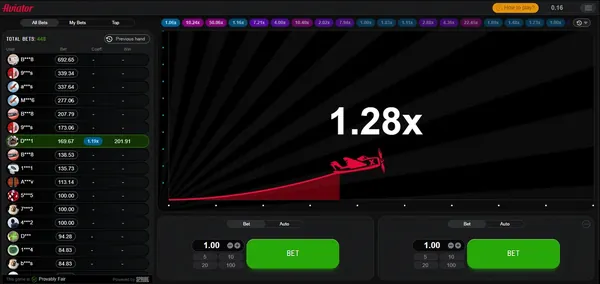
- 1Round history — closing multipliers of recent rounds, colour-coded by size
- 2Auto Cash-Out — set a target multiplier in advance and the payout fires the moment it is reached
- 3Live bets — All Bets, My Bets and Top Wins tabs show what every player is staking and winning
- 4Two bet panels — stake twice per round, each with its own Auto Play and Auto Cash-Out toggles
- 5Chat / Rain — public chat feed where operators drop free bets for the fastest players
The main game area shows the plane and the current multiplier; the betting panels hold the stake field, betting status, manual cash-out, Auto Cash-Out and the double-bet option. Placement differs slightly between bookmaker sites and apps, but the functions stay familiar everywhere.
Live Bets shows current player activity — a view of multiplayer action, not an instruction for your next bet. Other players' cash-outs do not affect your crash point.
The round-history bar records previous multipliers across the top. It helps you review what just happened, but it has no predictive value: a string of low multipliers does not make a high one due, and a recent high does not make the next crash more likely.
Rounds generally last 8 to 30 seconds, with roughly 60 to 90 rounds possible in an hour — that cadence exposes even a small stake repeatedly, so set your limits before the pace sets them for you.
Chat, Rain and competitions
In-game chat carries emojis, gifs and operator announcements. The Rain Promo drops free bets into the chat, and the first player to tap Claim takes each one. Operators can also grant free bets individually, in batches or through an API — all operator promotions, separate from the demo's virtual balance.
Tournaments and races rank participating players against a defined task with a live score bar and a leaderboard. Read the operator terms before joining: eligibility, expiry and wagering rules belong to the operator, not to the general Aviator mechanic.
PROVABLY FAIR
Is Aviator Fair?
The honest maths
Spribe's published game information puts Aviator at a 97% RTP with a 3% house edge. RTP is a long-run statistical measure, not a promise that your session will return 97% of your stakes. The 3% edge means the expected value of any bet is negative 3% of the stake, whatever cash-out target you pick.
The crash point is fixed before take-off. A SHA-256 hash of the server seed is published before the round begins, and client-side data from the first three bettors feeds into the result alongside that seed. Once the round ends, the inputs are revealed and you can check them with the in-game provably-fair tool.
Keep three complaints apart: different results, a target supposedly aimed at your account, and cash-out time-outs. The provably-fair process answers the result-generation question. A slow connection or device explains most manual cash-out time-outs — which is why Auto Cash-Out and a stable connection are practical safeguards.
P(m) = 0.97 / m
Probability of reaching a target. About 3% of rounds — roughly 1 in 33 — crash instantly at 1.00x. No target removes the edge.
Verify a round in three steps
01
Open round history
Pick the finished round in the top history bar and open its provably-fair details.
02
Reveal the seeds
The game shows the server seed after the round; the client data comes from the first three bettors.
03
Compare the hash
The verification tool recomputes the SHA-256 commitment. A match confirms the result was fixed before take-off.
Licensing context
Spribe's MGA B2B Critical Gaming Supply licence RN/189/2020 is active. The UKGC remote operating licence 000-057302-R-333085-001 is currently suspended in 2026, and Spribe games are unavailable at UKGC-licensed sites. Operator regulation is separate: Betway South Africa answers to the WCGRB, betPawa Nigeria to the NLRC, betPawa Malawi to MAGLA, and the listed Indian offshore sites use Curaçao licensing. Check the operator's current local terms before depositing.
LEGAL STATUS
Is Aviator Legal in Your Country?
Aviator is legal wherever your bookmaker holds a local licence. Spribe itself holds an MGA B2B licence (RN/189/2020) and a South African WCGRB certificate. Its UKGC licence is suspended in 2026. So Aviator is unavailable at UK-licensed sites.
| Country | Regulator / licence | How you play | Min age |
|---|---|---|---|
| Kenya | BCLB-licensed bookmakers | Betika, SportPesa, Odibets, betPawa | 18+ |
| Nigeria | NLRC (betPawa NG is NLRC-licensed) | SportyBet, BetKing, Betway NG | 18+ |
| South Africa | WCGRB (Spribe cert 10189818-001) | Betway ZA, Hollywoodbets, LottoStar | 18+ |
| Ghana | Licensed local bookmakers | SportyBet GH, Betway GH, betPawa GH | 18+ |
| India | No federal licence; offshore Curaçao sites | 1xBet, 1win, Mostbet; state rules vary | 18+ |
| United Kingdom | UKGC licence suspended 2026 | Unavailable at UKGC sites | — |
STRATEGY
Aviator Strategies and Bankroll Rules
Nothing beats the 3% house edge. A plan only changes how bumpy the ride is — pick the one that matches your budget and your nerves.
Low targets, steadier ride
Set Auto Cash-Out between 1.3x and 1.5x and grind. That band is often described as lower variance, with an approximate hit rate of 65% to 75%. A 1.5x or 2.00x auto setting is the common practical choice.
RiskLow
Dual-bet hedging
Split the round across two panels: one bet on Auto Cash-Out around 1.5x to 2x, the second chasing 5x to 10x or more. When the first lands it can cover both stakes — but a 2x target is reached only 48.5% of the time under the stated formula, so "safe" never means guaranteed.
RiskMedium
Progression systems
Martingale doubles the stake after a loss: after 10 consecutive losses the next stake is 1,024 times the base. Table limits and your bankroll arrive long before the progression recovers anything. Fibonacci and D'Alembert change the pace, not the negative 3% expected value.
RiskHigh
Warning
Past multipliers cannot predict the next crash. Colour sequences, streaks, time-of-day patterns and "due" high results are the gambler's fallacy — the round history is descriptive, not predictive.
A practical session framework
Start in demo mode, then use small stakes if you decide to play for real money. Keep each round at no more than 2% of your bankroll, establish a session budget and set an operator loss limit where available. Take breaks, never raise stakes to recover a loss, and stop when the budget or the limit is reached. With 60 to 90 rounds possible in an hour, even small stakes get exposed repeatedly — Auto Bet belongs behind a fixed round count and clear stop-on-win or stop-on-loss limits.
MOBILE APP
Aviator App and APK: What Is Official?
Is there an official Aviator app?
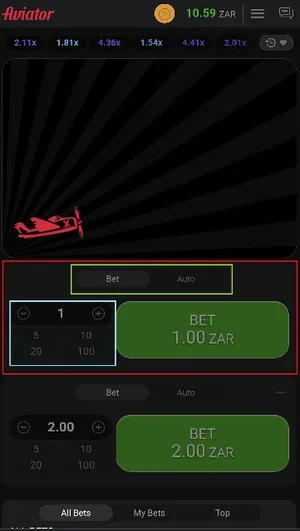
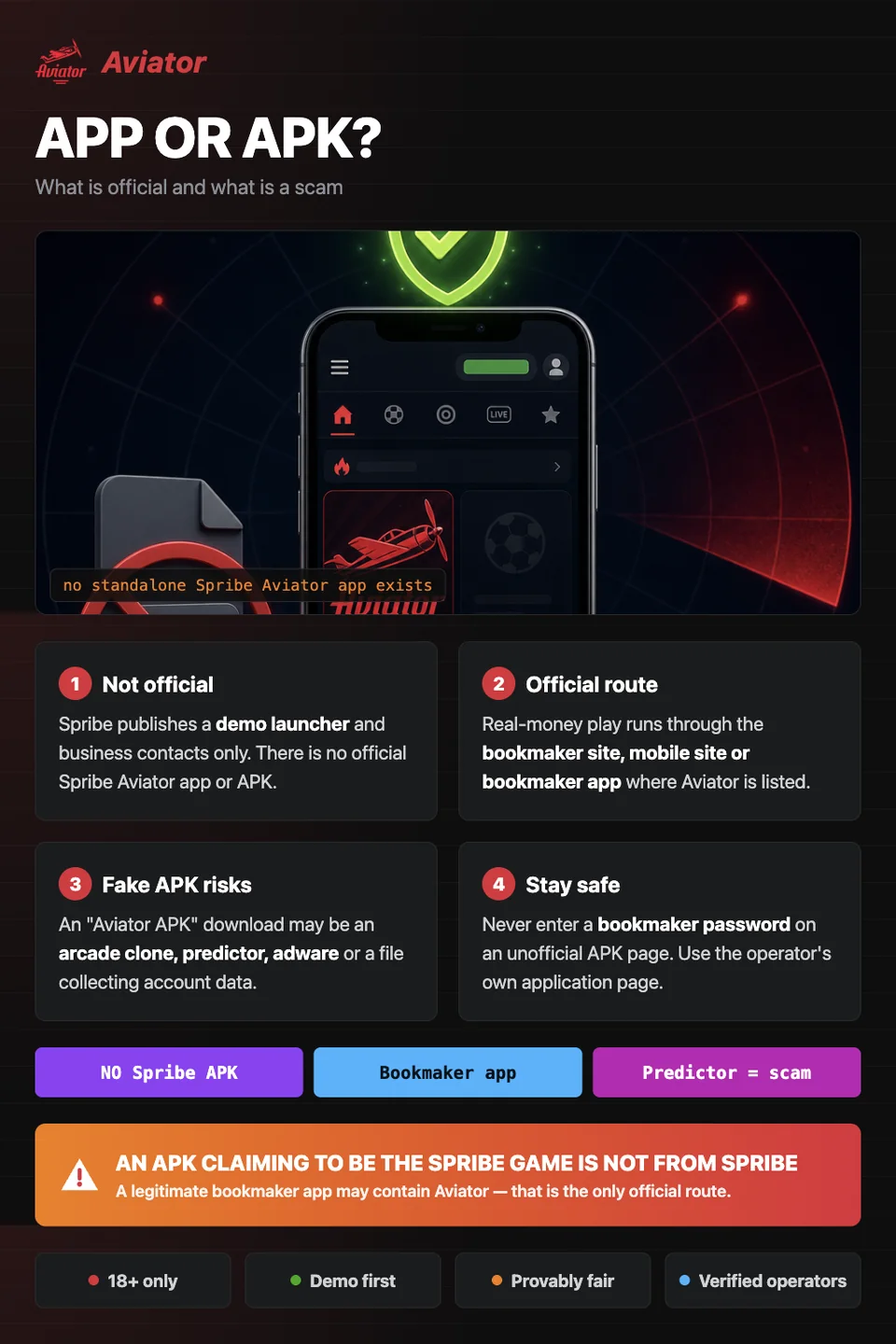
No — there are 0 official Spribe Aviator apps or APK files. Spribe publishes a demo launcher and business contacts only. Real-money Aviator runs inside licensed bookmaker apps and sites such as 1win, Betway, SportPesa or 1xBet, so an "Aviator APK download" from a mirror is either a clone, a predictor or adware.
- ✕No standalone Spribe Aviator app exists on Google Play or the App Store
- ✕An APK claiming to be the Spribe game itself is not automatically affiliated with Spribe
- ✕A third-party download may be an arcade clone, predictor, adware or a file collecting account information
Bookmaker apps and browser play
1xBet carries Aviator on its website and in its official app, with the game located through Casino, Crash or 1xGames; its Android APK is a bookmaker application, not a separate Aviator build. Betway offers an iOS and Android app, BetKing provides a mobile app and desktop access, and SportPesa, Odibets and other operators provide their own mobile surfaces — Odibets' lightweight app is listed at 2MB.
On iPhone, use the bookmaker's official iOS application where available or play through the browser; a browser shortcut or progressive web app puts the site on your home screen without sideloading anything. On a PC, Aviator runs in the browser through the operator site — there is no official Spribe PC installer.
How to avoid fake downloads
Be cautious with any file promising a predictor, hack, guaranteed multiplier, MOD balance or unlimited cash-out. A Play-store listing with virtual coins and a "no real-world value" disclaimer is a casual clone, not real-money Spribe Aviator — the listing identified as com.aviatorgame.onlineaviatorapp is gone, and the Softonic "Aviator" version 1.0 is an arcade game rather than the crash game.
Use the operator's own application page, verify the bookmaker name and confirm the game appears inside your logged-in account. Never enter a bookmaker password into an unofficial APK page. For a direct real-money route, use the button route on this page rather than an APK mirror.
MYTH VS FACT
Aviator Predictors, Signal Bots and APK Scams
Do Aviator predictor apps work?
No — 0 predictor apps can know the next crash point. The result is committed before take-off through a SHA-256 server-seed hash combined with client data from the first three bettors, and it is revealed only after the round. Anything selling "next round" multipliers — Telegram signals, hack APKs, MOD predictors — is a scam or adware.
MYTHA predictor app reads the public screen or the round history and forecasts the next crash point.
FACTThe crash point is sealed by a SHA-256 commitment before the round is visible to any player. Nothing shown on screen can reverse it.
MYTHA paid Telegram channel or "signal bot" posts genuine next-round multipliers.
FACTOperator warnings and independent guides describe these products as scams; the listed APK-dog predictor v1.9.4 carried a 0/10 rating and no credible mechanism.
MYTHVersion labels like v2.1, v4.0, v8 or v12 mark official predictor releases.
FACTNo official predictor product line exists. A "calculator" at best repackages the legitimate formula P(m) = 0.97/m as if it were a forecast.
A predictor may display random numbers, recycle recent round history, sell access to a chat channel or push an install wrapped in aggressive advertising. A signal bot can post a "prediction" after a round has started — too late to create an advantage.
Fairness verification is different from prediction: after a round, the in-game provably-fair control lets you inspect the revealed seeds and confirm how the completed round was generated. It cannot tell you what a future round will do.
Never pay for a signal subscription with money intended for play, never install an APK from an unknown mirror, and never hand bookmaker credentials to a predictor page. The safest "predictor" is the probability table, a defined budget and the knowledge that the 3% edge sits in every target choice.
WHERE TO PLAY
Where to Play Aviator for Real Money
Aviator is available through bookmaker sites and apps across Africa and South Asia, with the strongest player demand in India, Kenya, South Africa, Pakistan, Malawi, Zambia, Bangladesh, Zimbabwe, Tanzania, Ghana, Nigeria and Uganda. Lobby names and limits are operator-specific; 1win comes first as the direct real-money option on this page. Confirm currency, account eligibility, local rules, payment terms and current limits before you deposit.
Showing 11 of 11
RECOMMENDED
1win
Min stakefrom about $0.10 equivalent
Max winCheck the current operator terms
The direct real-money route on this page.
PlayBetway
Min stakeR1 in South Africa; other markets set their own
Max win$250,000 per round
Casino or Instant Games; WCGRB in South Africa.
See siteHollywoodbets
Min stakeR5 preset
Max winR5M per bet, R10M per round
Presets include R5, R10, R20 and R100.
See siteBetika
Min stakeKES 10
AccessTop menu; two bets available
Find Aviator in the top menu.
See siteSportPesa
Min stakeKsh 2
MaxKsh 50,000 stake · Ksh 4.5M win per bet
M-PESA Paybill 955100.
See siteOdibets
Min stakeKSh 1
MaxKSh 50,000 stake · KSh 1,000,000 payout per ticket
M-PESA Paybill 290680; lightweight 2MB app.
See siteSportyBet
Missionsfrom 250 NGN or 500 NGN
Pool4,000,000 NGN weekly
Aviator Missions run on set windows.
See siteBetKing
Min stakefrom ₦10
CapsPer-slot caps apply
Menu → Casino → Aviator; 50 free bets promotion after ₦50,000 Aviator stake within 7 days.
See sitebetPawa
Min stake₦1 or KSh1
Max win₦340M in Nigeria · KSh32M in Kenya
Per stated operator limits.
See siteLottoStar
Min stakeR1
Max winR50M since September 2025
Found under Quick Games.
See site1xBet
Min stake0.1 USD equivalent
Range0.1 to 100 USD-equivalent; game id 52358
Native Android APK and iOS app.
See siteOffshore bookmakers
Min stakeINR 1
PaymentsUPI, Paytm, PhonePe, BHIM
1win, Mostbet, 4rabet, Rajabets, Batery, Parimatch and Pin-Up in the listed material; terms vary by operator.
See siteCountry notes
In Kenya, SportPesa places Aviator behind the Aviator tab and may require transferring chips to the casino wallet through the blue chip control; its payment route includes M-PESA Paybill 955100. Odibets lists M-PESA Paybill 290680 and SMS registration keyword "ODI" to 29680. Betika places Aviator in the top menu and lists a KES 10 minimum.
In Nigeria, betPawa lists OPay, PalmPay, MTN MoMo, Airtel SmartCash, bank transfer and USDC among its deposit options. SportyBet's Aviator Missions carry a 4,000,000 NGN weekly pool with mission windows listed as 10 to 13 and 19 to 22. BetKing files the game under Menu, Casino and Aviator.
In South Africa, Betway lists the game under Casino or Instant Games with a R1 minimum; Hollywoodbets uses R5, R10, R20 and R100 presets; LottoStar lists Aviator under Quick Games with a R1 minimum. In Ghana, SportyBet, Betway and betPawa are the listed markets — a reported betPawa result describes a GH¢6M win from 2 × GH¢20 in Kumasi on 3 November 2023.
In India, the listed affiliate material includes 1xBet, 1win, Mostbet, 4rabet, Rajabets, Batery, Parimatch and Pin-Up, with INR 1 as the common minimum. India and Pakistan drive the fastest-growing search cluster around the Aviator APK and Aviator 2.0 APK, so install steps and safety warnings matter most there.
In Malawi, Zambia, Zimbabwe, Tanzania and Uganda the game rides on the same regional bookmakers that serve Kenya and South Africa. For any market not listed above, including Bangladesh and the Philippines, check the licensed local bookmaker rather than an APK file or an unverified operator list.

BONUSES
Aviator Bonuses and Welcome Offers
Crash games can count 0-5% towards bonus wagering. Always check the T&C before you claim.
| Operator | Offer | Aviator-only? | Condition / note |
|---|---|---|---|
| 1win | 500% welcome + 500 FS; IN: 500% fiat / 600% crypto up to 45,000 INR | No | Details not published |
| Betway ZA | 10 Free Flights on Aviator | Yes | T&C not published |
| BetKing | 50 Free Bets | Yes | Stake ₦50,000 on Aviator in 7 days |
| Hollywoodbets | R25 sign-up bonus; Make It Rain free bets | No | Rain drops free bets in chat |
| Odibets | No-deposit free bet for new customers | No | Weekly free bet per 4 bets |
| SportyBet | Aviator Missions, 4,000,000 NGN weekly pool | Yes | Mission terms apply |
| 4rabet | 700% crash bonus to 4,000 INR | No | Details not published |
| Parimatch IN | Up to 150k INR + 150 FS | No | Details not published |
PROMOS
Aviator Rain, Free Bets and Tournaments
Rain drops free bets into chat at set hours, and the first player to tap "Claim" wins each one. At Hollywoodbets, claimed free bets must be activated within 30 minutes, and winnings count only from multipliers of 2x or higher.
| Operator | Promo | What you get | Condition |
|---|---|---|---|
| Hollywoodbets | Make It Rain | R1M giveaway (May 2024), R20 free bets dropped 19:00–21:00 | Bet R10+ to qualify; claim within 30 minutes |
| SportPesa | Aviator Rain + Aviator Challenge | Ksh 1M per day in Rain free bets; Ksh 10M Challenge prize pool | Play Aviator during promo periods |
| SportyBet | Aviator Missions | 4,000,000 NGN weekly pool; Tuesday Collect 100x cumulative pays 2,000 NGN to the first 500 players; Saturday Catch 10 cash-outs at ≥3x | Min 250 NGN (Tue) / 500 NGN (Sat); free bets valid 3 days |
| BetKing | 50 Free Bets | 50 free bets, usable only on Aviator | Stake ₦50,000 on Aviator within 7 days; claim in-game |
| Betway ZA | 10 Free Flights | 10 free Aviator bets as a welcome offer | Full T&C not published on the readable page — check the operator |
Tournaments (races) add competition: complete tasks, collect points and climb the leaderboard for a share of the prize pool, with a live score bar tracking you inside the game. No separate sign-up beyond the operator's promo terms.
RECORD WINS
Biggest Aviator Wins on Record
- GH¢6,000,000 — betPawa, Ghana: Fuseini from Kumasi won GH¢6M on 3 November 2023 from two bets of GH¢20 each.
- R10,000,000 — Hollywoodbets, South Africa: a mobile player hit the R10M per-round cap on 10 April 2024, cashing out at 3571x.
- R13.6 billion paid out — LottoStar, South Africa: by November 2023 LottoStar reported paying out over R13.6 billion on Aviator in total.
These are rare cases, not expectations. The chance of a round even reaching 100x is 0.97% — about one in a hundred — and thousand-x multipliers are far rarer. Headlines come from millions of rounds, and the 3% edge applies to every one of them.
PAYMENTS BY REGION
Aviator Deposits and Withdrawals
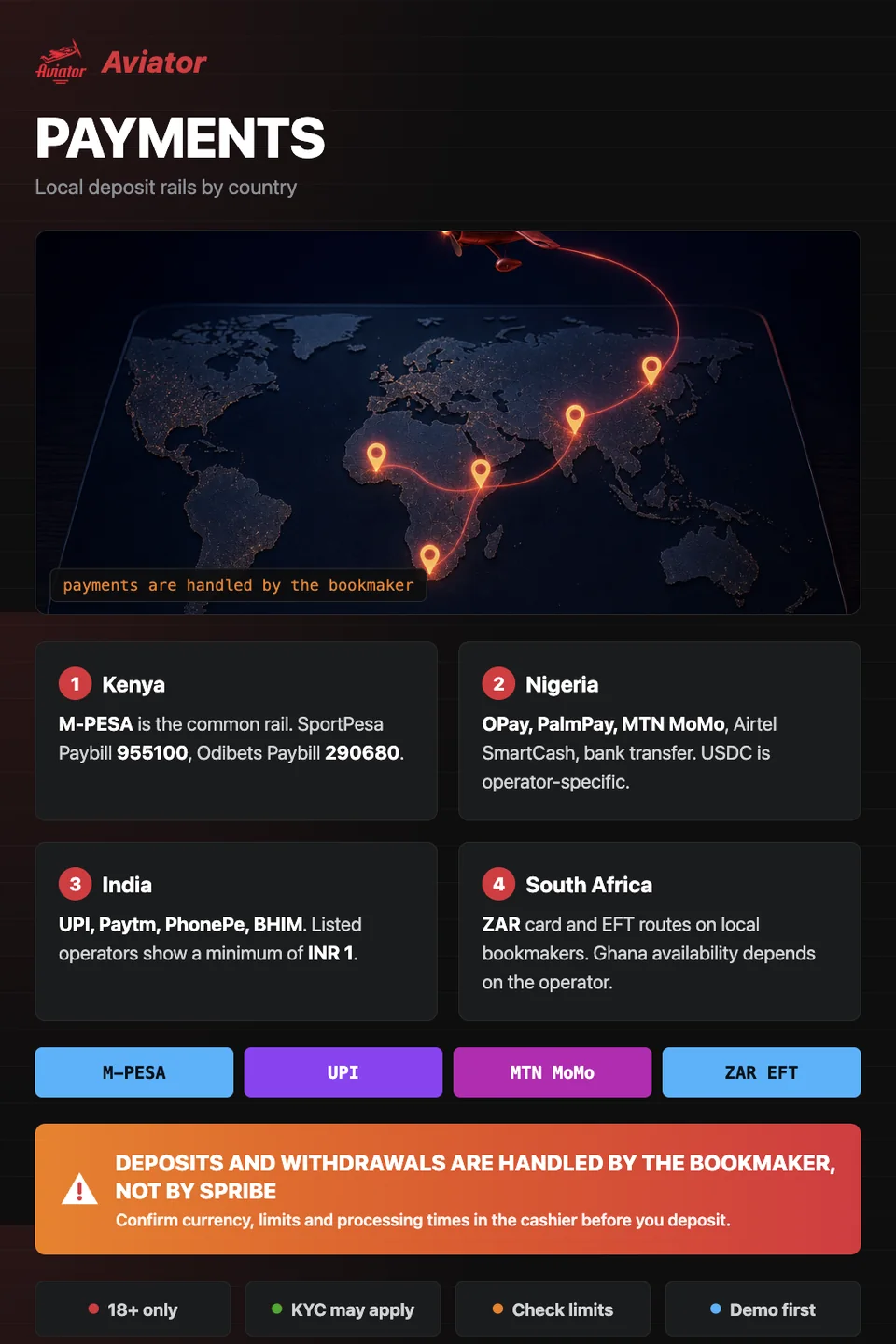
Your Aviator balance lives in the bookmaker wallet, so deposits and withdrawals are handled by the operator rather than by Spribe. Register or sign in, complete any identity checks, pick the payment method shown for your country and confirm the amount before launching the game. Minimum deposits, processing times, fees and available rails are operator-specific.
Kenya (KES)
M-PESAPaybillSMS registration
Kenyan players commonly search for M-PESA access. SportPesa lists Paybill 955100 and Odibets lists Paybill 290680; SportPesa also uses a casino-wallet chip transfer before play. SMS registration: "ACCEPT" to 79079 (SportPesa), "ODI" to 29680 (Odibets). Minimum stakes start at KSh 1 on betPawa and Odibets, KSh 2 on SportPesa, KES 10 on Betika.
Nigeria (NGN)
OPayPalmPayMTN MoMoAirtel SmartCashBank transferUSDC
Nigerian betPawa options include OPay, PalmPay, MTN MoMo, Airtel SmartCash, bank transfer and USDC. USDC is an operator-specific option and should not be treated as a general Aviator payment method. Stakes start from ₦1 on betPawa and ₦10 on BetKing, and payout caps reach ₦340,000,000 on betPawa NG.
South Africa (ZAR)
CardsEFTVouchers
South African players see ZAR payment routes on local bookmakers. Hollywoodbets registration can require FICA documents. Minimum bets start at R1 on Betway and LottoStar, while Hollywoodbets works with R5 presets.
Ghana (GHS)
Mobile moneyOperator account
Ghanaian availability depends on the operator account and local terms; SportyBet, Betway and betPawa are the listed markets.
India (INR)
UPIPaytmPhonePeBHIM
Indian listings include UPI, Paytm, PhonePe and BHIM, with INR 1 shown as a minimum at listed operators. Licensing, bonuses and withdrawal rules vary by operator.
Registration and verification
Some operators support registration by phone, email, social account or one-click flow. These processes are controlled by the operator and differ by country — use only payment details belonging to you, check that the account name matches the withdrawal method, and read the wagering conditions attached to any bonus. Crash games may contribute between 0% and 5% toward some bonus wagering requirements, so a deposit bonus is not automatically cleared by playing Aviator; a promotion can also carry an expiry date, a minimum stake or an Aviator-only restriction.
Withdrawing winnings
After a successful cash-out, funds first appear in the operator balance. Request the withdrawal through the same account area used for deposits or through the payment option offered by the bookmaker. Processing time is not uniform across the listed markets — check the operator's current terms rather than a general promise, and if a withdrawal is pending, contact operator support and keep your transaction details.
GETTING IN
How to Register and Get Help
Signing up takes a few minutes. Here are the steps for four popular operators, plus where to get help.
SportPesa KE
- SMS "ACCEPT" to 79079 to register.
- Deposit via M-Pesa Paybill 955100.
- Move chips to your casino wallet with the blue chip.
- Open the Aviator tab and place your bet.
Odibets KE
- SMS "ODI" to 29680 or register on the website.
- Deposit via M-Pesa Paybill 290680.
- Optionally install the 2MB app.
- Tap Aviator in the top nav.
Betway ZA
- Sign up on the site or app.
- Go to Casino, then Instant Games, then Aviator.
- Complete ID verification before withdrawals, per SA rules.
1xBet
- Register by 1-click, phone, email or social. You must be 18+.
- Go to Casino, then Crash, then Aviator (game id 52358).
- The app is optional. The site works fine.
Support
Use the operator's in-app chat or help centre first. SportPesa and Odibets also list customer-care lines on their sites. Keep your account details ready when you contact them.
GETTING STARTED
From Free Demo to First Real Bet
- Practise in the free demo from Spribe or your operator. Learn the two-bet layout and auto cash-out without risking money.
- Choose a licensed operator. WCGRB-licensed in South Africa, NLRC-licensed in Nigeria, or a licensed Kenyan bookmaker.
- Register an account. You must be 18 or older. Expect ID or FICA checks where required.
- Deposit with a local method: M-PESA Paybill 955100 (SportPesa) or 290680 (Odibets) in Kenya, OPay or PalmPay in Nigeria, UPI in India.
- Find Aviator in the lobby: Betika's top menu, Betway under Casino → Instant Games, the SportPesa Aviator tab, or BetKing via Menu → Casino.
- Start small with the minimum stake and a cautious 1.5x-2x auto cash-out. Set a session budget before you begin.
DEVELOPER
Who Makes Aviator: Spribe in Brief
Spribe is a game studio founded in Georgia, best known for Aviator — the game that brought the crash format from crypto casinos into regular online casinos.
- Aug 2018 Spribe founded in Tbilisi. David Natroshvili is co-founder and CEO.
- Early 2019 Aviator launches in January. First live on Adjarabet in February 2019.
- 15 Aug 2019 Aviator 2.0 released: 40% faster, lighter for slow connections, with chat and the new Rain feature.
- Dec 2020 Over 300 operators carry Spribe games. MGA licence granted in November 2020.
- Feb 2022 Certified in more than 20 jurisdictions.
- Oct 2023 UFC partnership announced. Aviator passes 10 million monthly players.
- 2025–26 SPRIBE-wide figures reach 50M+ monthly active players, 350,000 bets per minute, 60+ countries. Africa accounts for 35% of the player base. India is the fastest-growing market.
Spribe runs offices in Tbilisi, Kyiv, Warsaw, Tallinn, Curaçao and the Isle of Man. It holds an active MGA B2B licence (RN/189/2020) and a WCGRB certificate for South Africa; its UKGC licence (000-057302-R-333085-001) is suspended as of 2026, so Spribe games are unavailable at UKGC-licensed sites.
RESPONSIBLE GAMBLING
Responsible Aviator Play
18+
- Aviator has a 3% house edge and high variance: a low target can lose, and a high target can produce long losing streaks.
- Rounds run 8 to 30 seconds — 60 to 90 rounds per hour can make a session feel shorter than it is while total exposure grows fast.
- Set a budget before opening the game and treat it as entertainment money; keep each round at no more than 2% of your bankroll.
- Never borrow money, never use essential funds, and never chase a previous loss with a larger stake.
- Use the operator's tools: deposit caps, loss limits, session reminders and cooling-off timers. Auto Bet belongs behind a fixed round count and a stop-on-loss amount.
Set a deposit limit before you start. If gambling is becoming difficult to control, stop using the account and contact a recognised gambling-support service in your country. Aviator is for adults aged 18 and over, subject to the laws and operator rules where you live.

GLOSSARY
Aviator Glossary
- Crash point
- The multiplier where the round ends. The game locks it before take-off. It can be as low as 1.00x.
- Multiplier
- The rising number during a round. Your payout is your stake times whatever it reads when you cash out.
- Cash Out
- The button that settles your bet at the current multiplier. Miss it before the crash and the bet is gone.
- Auto Cash-Out
- A preset multiplier where the game cashes out for you automatically. It takes reaction time out of the decision.
- Auto Play
- Automatic betting for 10-100 rounds. Optional stop-on-win and stop-on-loss limits protect your balance.
- Double bet
- Two bets placed in the same round. Each cashes out separately with its own settings.
- Round history
- The strip of past multipliers at the top of the screen. Rounds are independent, so it tells you nothing about the next one.
- Live bets
- The panel listing all players' bets, your own bets, and the top wins for the day, month and all time.
- Rain
- A promo where the operator drops free bets into the chat. The first player to tap "Claim" gets each one.
- Provably fair
- The game publishes a fingerprint of its secret number before the round. The numbers are revealed afterwards, so anyone can check the result.
- Server / client seed
- A secret number from the game, plus numbers from players' devices. Combined they fix the crash point. Neither casino nor Spribe can alter it.
- RTP
- Return to Player — 97% for Aviator. For every $100 bet, the game pays back about $97 over the long run.
- House edge
- The casino's built-in cut: 3% in Aviator. The game keeps about $3 of every $100. It holds partly because ~3% of rounds crash instantly at 1.00x.
FAQ
Aviator Frequently Asked Questions
Aviator is a Spribe crash game in which a plane rises with a multiplier. You cash out before the crash point or lose the active stake.
Open Aviator through a bookmaker, choose a stake, watch the multiplier and cash out manually or with Auto Cash-Out before the plane flies away.
The published RTP is 97%, implying a 3% house edge. The expected value is about minus 3% of the stake at every cash-out target.
Aviator uses a provably-fair process with a pre-round SHA-256 server-seed hash, client-side data and post-round verification. Check the completed round in the game's verification tool.
No. The crash point is committed before take-off, so predictor APKs, Telegram signals and hack claims cannot reliably calculate the next result. Treat them as scams or adware.
About 3% of rounds, approximately 1 in 33, crash instantly at 1.00x. This is part of the probability model that produces the 3% house edge.
No. Auto cash-out, two-bet systems, Martingale, Fibonacci and D'Alembert change variance or stake timing but cannot remove the negative expected value.
The multiplier is operator-dependent, and Spribe does not publish one universal maximum. It is commonly stated as reaching 1,000,000x or more in some operator material, but win caps per round apply.
It depends on the operator: examples include R1 at Betway South Africa, KES 10 at Betika, ₦1 at betPawa Nigeria, Ksh 2 at SportPesa and INR 1 in listed Indian operator material.
Yes. Aviator provides two independent betting panels, and each bet can be cashed out separately.
Yes. Set a multiplier in the relevant betting panel and the game attempts to cash out automatically when that target is reached.
No. Spribe does not provide a standalone player app or APK. Use the bookmaker's official website or app, and avoid third-party downloads claiming to be the Spribe game.
REVIEWS
Player Reviews and Discussion
Reader reviews do three jobs here: they rate how clear this Aviator guide is, they report real demo, payment and app issues, and they feed the FAQ above. Check the visible ratings, reply to useful questions and add your own feedback — every review is read before the page is updated.
Recent reviews
SUMMARY
Aviator: Demo First, Then Play Carefully
Aviator is a fast crash game built around one clear decision: cash out before the rising multiplier crashes. The demo is a practical way to learn the two betting panels, manual cash-out, Auto Cash-Out, round history and the live interface without risking money. For real-money play, use a bookmaker account and confirm the local stake, payment and withdrawal rules.
The useful facts are straightforward. Aviator has a 97% RTP and a 3% house edge, the crash point is fixed before take-off under a provably-fair process, and every strategy changes variance rather than expected value. Predictors, signal bots and unofficial APKs cannot provide a reliable advantage. Set a budget, keep stakes controlled and stop when your limit is reached.
Ready to fly?
Try the demo first, then play for real at 1win.
